
An AI Engagement
may reveal:
-
Weak data foundations
-
Architecture constraints
-
Cybersecurity gaps
-
Skills shortages
-
Infrastructure investment needs
Services
Tell us what is getting in the way, what opportunity you want to capture, or what outcome you need to achieve. We’ll help you understand what is really driving it, identify the options, decide what to prioritise and support implementation where needed.

Our services represent high-value questions organisations commonly bring to us. They provide a practical starting point. They are not rigid consulting silos, and they do not define the full range of questions Xirocco Strategy Suite and Maeros AI can help investigate.
Technology strategy should begin with what the organisation is trying to achieve. We help connect business priorities to the capabilities, applications, architecture, operating model, investment and technology needed to support them. The result is a strategy that explains not only what should change, but why it matters. Typical questions include:
Are our technology priorities genuinely aligned with business strategy?
Which capabilities matter most to the organisation's future?
Where is technology helping—or constraining—those capabilities?
What should the target state look like?
Which changes and investments should happen first?
How do we keep strategy relevant as conditions change?
Running AI pilots is very different from operating AI safely and effectively at enterprise scale.
We help organisations understand the strategy, architecture, governance, readiness, operating model and investment required to move from experimentation towards sustainable enterprise capability.
That includes understanding whether the underlying organisation is technically ready to scale AI across areas such as:
Data
Cybersecurity
Infrastructure
IT capability
Architecture
Governance
Operating model
Typical questions include:
Where should AI create meaningful value?
Are we ready to scale beyond isolated pilots?
What architecture is required?
What should the AI operating model look like?
Which technical weaknesses could prevent scale?
Where should investment be prioritised?
Explore AI Strategy, Architecture Blueprinting & Operating Model →
Transformation plans often describe the destination without fully understanding whether the existing organisation can support the journey. We help leaders assess the enterprise conditions that may enable, slow or prevent change. That can include:
Applications
Data
Infrastructure
Cybersecurity
Suppliers
Architecture
Skills and capability
Operating model
Investment
Organisational readiness
Typical questions include:
What could prevent this transformation from succeeding?
Which existing weaknesses need to be addressed first?
Is the technology estate capable of supporting the future state?
Where are the most important dependencies?
Which issues are structural rather than programme-specific?
Where should leadership intervene first?
Cybersecurity is not only a technical issue. A weakness matters because of the business capability, operational process, asset, supplier or service it may affect. We help organisations understand cyber exposure in context across both IT and operational technology environments. This can include:
Structural cyber exposure
IT and OT dependencies
Critical assets and capabilities
Supplier exposure
Resilience
Operational technology health
Investment priorities
Critical National Infrastructure considerations where relevant
Typical questions include:
Where is our greatest structural cyber exposure?
Which weaknesses could have the greatest operational impact?
How healthy is our OT environment?
Which IT/OT dependencies create hidden risk?
Which cyber investments should be prioritised?
Where could resilience fail across connected systems and suppliers?
Most organisations have more legitimate technology demand than available budget. The challenge is not simply deciding which projects score highest. It is understanding what the organisation gains—or gives up—when an investment is funded, deferred, reshaped, sequenced or rejected. We help connect technology investment decisions to:
Business priorities
Strategic capabilities
Architecture
Risk
Transformation
Cost
Dependencies
Readiness
Typical questions include:
Which investments are most important to strategy?
What happens if the budget is reduced?
Which initiatives should be protected?
Which can be deferred?
Which should be reshaped?
What dependencies make sequencing important?
Which proposals should not proceed?
Digital sovereignty is not determined by a supplier's headquarters or the physical location of a data centre alone. Organisations can depend on complex chains of software, cloud services, infrastructure, support arrangements, jurisdictions and technology suppliers. We help make those dependencies visible. The objective is to understand where strategic control may be constrained and what that means for architecture, suppliers, risk and future decisions.
Typical questions include:
Where are our most important sovereignty dependencies?
Which critical services depend on foreign jurisdictions?
What hidden supplier or technology dependencies exist?
Where could legal jurisdiction affect strategic control?
Which workloads or capabilities require greater sovereignty?
What changes would materially improve our position?
Technology cost reduction should not begin with arbitrary percentages. A saving is valuable only if the organisation understands what it is removing, consolidating, renegotiating or changing—and what that decision may affect. We help identify opportunities across applications, infrastructure, suppliers, technology and investment while keeping strategic capability and resilience visible.
Cost opportunities can emerge naturally as the wider technology estate is understood. Typical questions include:
Where are we paying for technology that no longer supports strategy?
Which applications or services overlap?
Where is supplier spend disproportionate to value?
Which planned investments could be avoided or reshaped?
Which apparent savings would create unacceptable capability or resilience impact?
Where can savings be achieved without weakening the organisation?
You do not need to model the whole organisation before beginning. Start with:
One important problem
One executive question
One high-value decision
Build the minimum connected context needed to address it. Demonstrate value. Then expand if other questions become important.
Technology strengthens the work. It does not replace professional judgement. Xirocco engagements combine:
Enterprise evidence
Structured expert assessment
Tacit and institutional knowledge
Connected strategic context
AI-assisted analysis
Experienced advisers remain responsible for interpretation, challenge, recommendations and professional judgement.
A useful strategy cannot be built from formal data alone. Xirocco brings together three forms of enterprise knowledge.
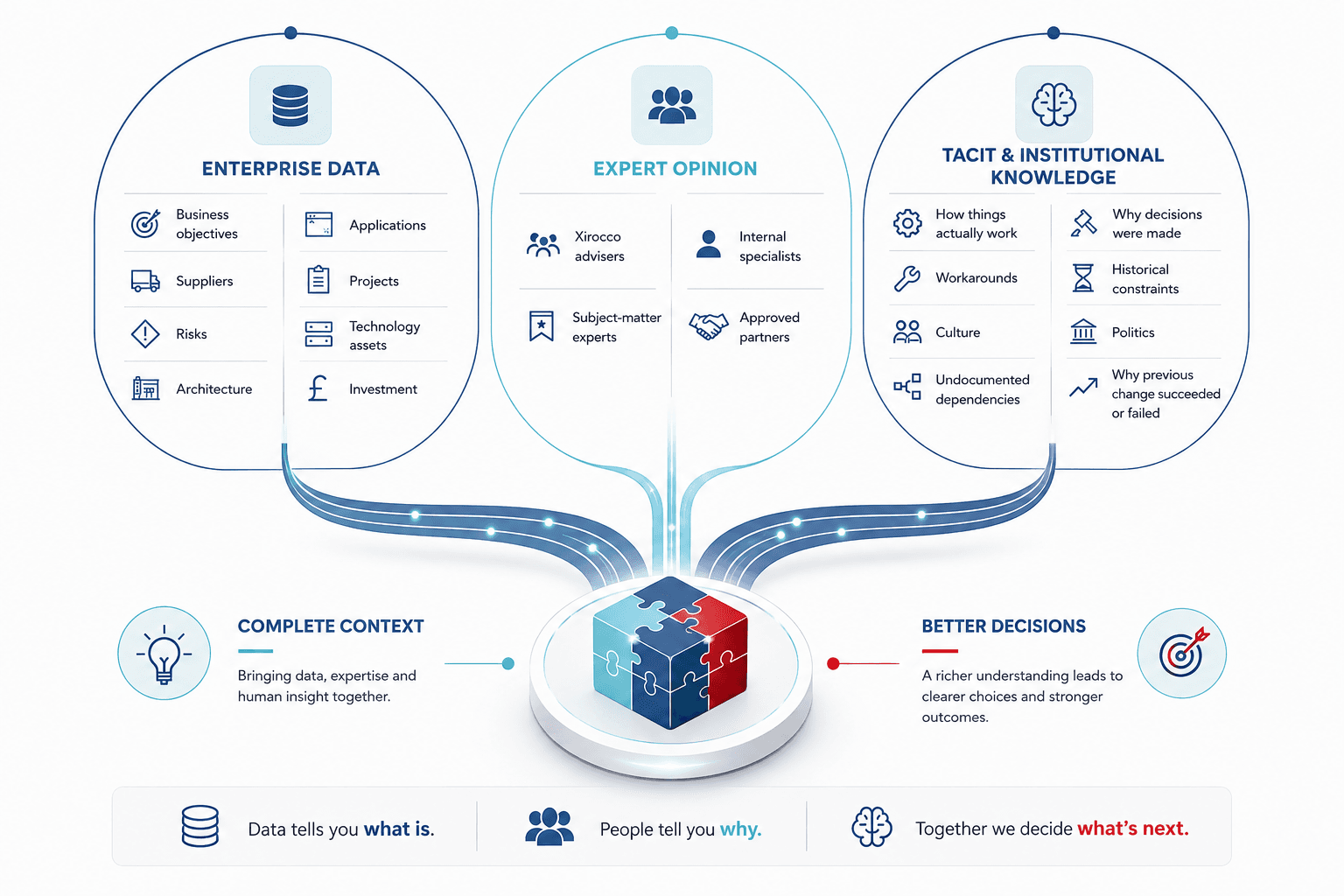
Formal information such as:
Business objectives
Applications
Suppliers
Projects
Risks
Architecture
Technology assets
Investment
Structured professional assessment from:
Xirocco advisers
Internal specialists
Subject-matter experts
Approved partners
The context held in people's heads about:
How things actually work
Why decisions were made
Historical constraints
Workarounds
Culture
Politics
Undocumented dependencies
Why previous change succeeded or failed
Bringing these together creates a stronger basis for strategic decisions.
Consulting engagements may begin with a well-defined scope, a clear challenge or an open question. In every case, Xirocco Strategy Suite and Maeros AI connect that starting point to the wider context needed to make a sound decision and create lasting value.
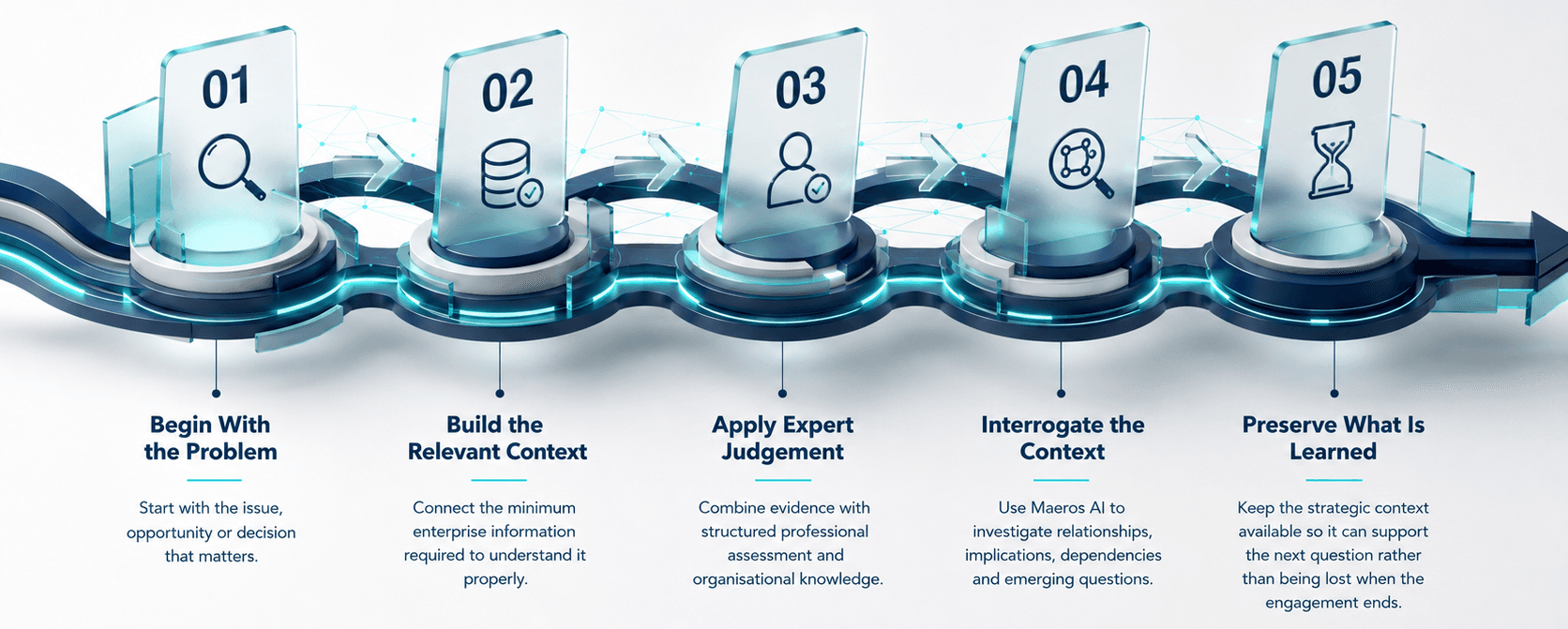
Start with the issue, opportunity or decision that matters.
Connect the minimum enterprise information required to understand it properly.
Combine evidence with structured professional assessment and organisational knowledge.
Use Maeros AI to investigate relationships, implications, dependencies and emerging questions.
Keep the strategic context available so it can support the next question rather than being lost when the engagement ends.
These services are not isolated disciplines. The same connected enterprise context can support multiple strategic questions. For example:
may reveal:
Weak data foundations
Architecture constraints
Cybersecurity gaps
Skills shortages
Infrastructure investment needs
may reveal:
Application duplication
Strategic misalignment
Supplier dependency
Transformation opportunities
Investment that can be avoided
may reveal:
Legacy technology barriers
Weak operating-model capability
Cyber exposure
Investment priorities
Data or supplier dependencies
may reveal:
Architecture concentration
Supplier dependency
Resilience concerns
Procurement choices
Strategic control issues
Choose the platforms on their own or combine them with the expertise and delivery support that best fits your needs.
License Xirocco Strategy Suite and Maeros AI for direct use by your internal team. Apply your own expertise to develop, maintain and interrogate your strategy, with optional onboarding and training but no requirement to purchase consulting services.
Combine our platforms with focused support from Xirocco Consulting—the strategy and technology specialists behind them. Engage us for the specific advisory, facilitation or implementation services you need to accelerate progress and gain more value from your investment.
Work with one of our approved consulting partners where you need deep sector expertise, local-market knowledge or multilingual delivery. Alternatively, bring a trusted adviser or incumbent partner you already use. We can train them to use Xirocco Strategy Suite and Maeros AI, allowing you to retain the relationships and expertise you value.
Tell us what is getting in the way, what opportunity you want to capture, or what outcome you need to achieve. We’ll help you understand what is really driving it, identify the options, decide what to prioritise and support implementation where needed.